Power Banks for Outages and Travel
A good power bank keeps a phone alive through an outage or a long travel day. Choose by usable capacity, charging speed and, if you fly, its watt-hour rating.
What to Look For
The number on the box (mAh) is only part of the story.
Capacity in Wh
Airlines regulate watt-hours, not mAh. Most banks list Wh on the label; Wh = mAh x volts / 1000.
Output (W) and ports
USB-C Power Delivery output decides whether it can charge a laptop or just a phone, and how fast.
Size and convenience
Built-in cables, displays and pass-through charging add convenience; bigger banks add weight.
Our Picks
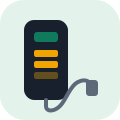
A high-output laptop-capable bank, a small value bank and a compact bank with a built-in cable.
As an Amazon Associate I earn from qualifying purchases.
Picks are based on manufacturer-published specifications and the buying criteria on this page, not on paid placement or hands-on lab testing. Specs quoted are the manufacturer's; check the listing for the current model before you buy.
How to Choose a Power Bank
A power bank is a small lithium-ion battery with USB ports. In an outage it keeps phones, earbuds, headlamps and small radios running; on a trip it rescues a dying phone at the gate. Choosing one comes down to real capacity, output, size and, if you fly, the watt-hour rating.
mAh versus Wh
Power banks are usually advertised in milliamp-hours (mAh), measured at the internal cell voltage, typically about 3.6 to 3.7 volts. Phones also list battery size in mAh, so it's tempting to divide one by the other, but voltage conversion and heat mean you'll get noticeably less than the headline figure. Many manufacturers quote a "rated capacity" at 5 V that's closer to reality. Watt-hours (Wh) are a more useful measure because they account for voltage: Wh = mAh x V / 1000. A 10,000 mAh bank at 3.7 V is 37 Wh; a 20,000 mAh bank is about 74 Wh. Airlines regulate power banks by watt-hours, so it helps to know yours.
Output and ports
USB-C Power Delivery (PD) output is the key spec. Phones charge quickly at around 20 to 30 W; tablets and many laptops need 45 to 100 W or more. If you want to charge a laptop, check both the bank's maximum output and how it's shared when more than one device is plugged in. USB-A ports are handy for older cables and small gadgets. Pass-through charging lets you charge the bank and a device at the same time.
Size and weight
A 10,000 mAh bank fits a pocket and gives roughly one to two phone charges, depending on the phone. Banks of 20,000 to 27,000 mAh are better for outages or for charging laptops but weigh considerably more. Banks above roughly 27,000 mAh at 3.6 to 3.7 V usually cross the 100 Wh line that matters for air travel.
Convenience features
- Built-in cables mean one less thing to forget.
- Displays show remaining charge as a percentage instead of four dots.
- Fast self-recharging matters when power returns briefly or you have a short layover.
Safety and storage
Buy from established brands that publish safety certifications, and stop using any bank that swells, gets unusually hot or smells odd. Don't leave power banks charging unattended on beds or sofas. For long-term storage in an outage kit, many manufacturers suggest keeping lithium batteries partly charged and topping them up every few months.
Flying with a power bank
Under FAA rules, power banks must go in carry-on baggage, never checked, and banks over 100 Wh need airline approval. International rules tightened in 2026, and many airlines restrict using power banks onboard. Read our guide to power banks and airline rules before you fly.